

Buster Keaton
— Source
- Styles
- comédie, drame, film et téléfilm d'action, film muet, film ou téléfilm d'aventure
Buster Keaton — American actor and filmmaker — concert schedule in Paris.
Upcoming dates
4 upcoming dates
Upcoming concerts
-
Film concerts
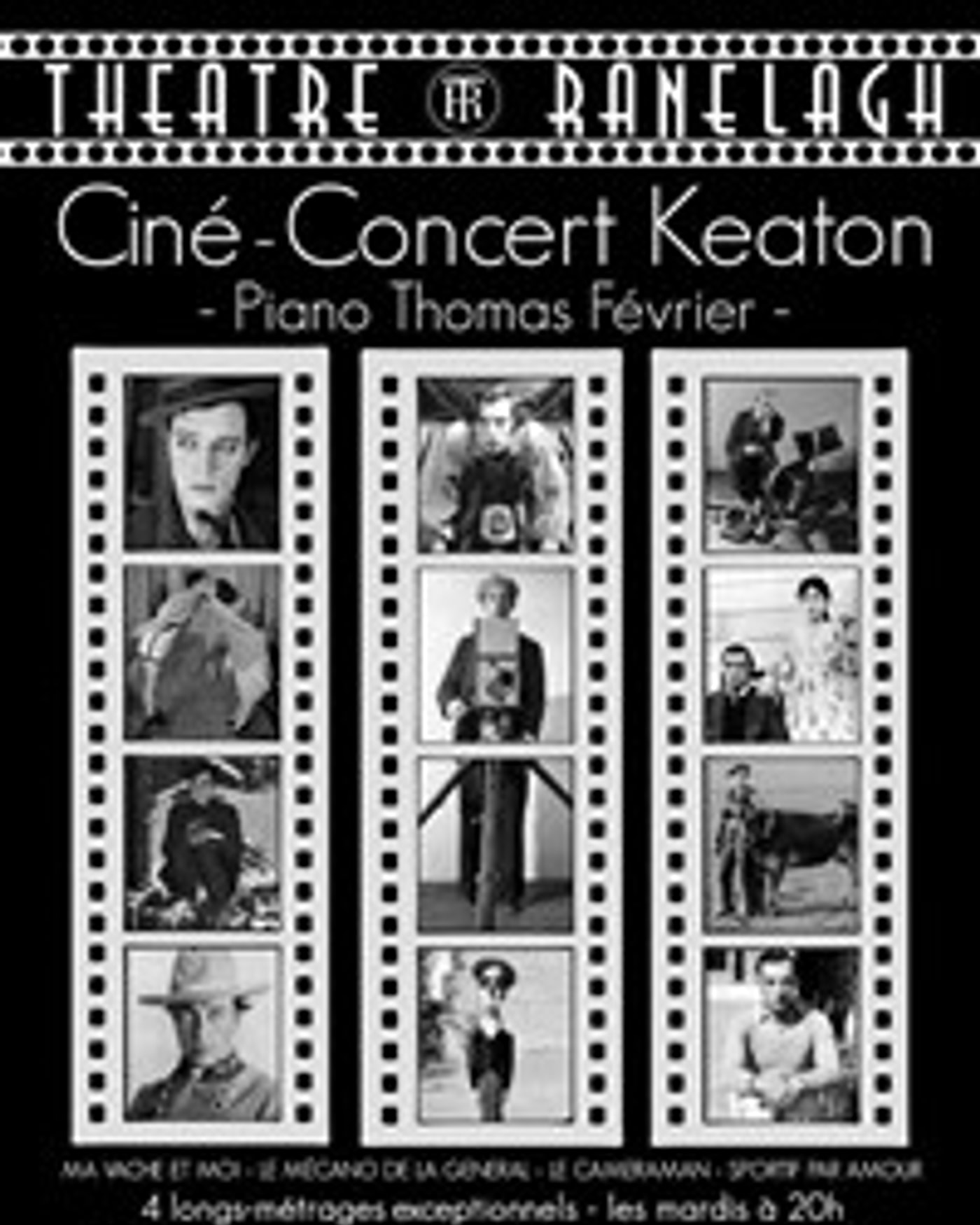
Ciné Concert Buster Keaton
Theatre le Ranelagh · 16th
from €10.95 Book now from €10.95
🔔 Be notified as soon as a new date is announced
Buster Keaton plays in Paris soon. Leave your email: we write you the moment a concert is announced — nothing else.
Profile
- Born
- 1895 · Kansas
- Origin
- États-Unis
- Active since
- 1917
About — The artist
Joseph Keaton Jr., known as Buster Keaton, was an American actor, director, screenwriter, producer, and stuntman, born on October 4, 1895, in Piqua, Kansas, and died on February 1, 1966, in Hollywood, California. A comedian famous for his deadpan expression, an artist who left his mark on American silent cinema, he was nicknamed, among other things, “the Great Stone Face” in contrast to Charlie Chaplin. “Buster” is a generic nickname (“pal”) also meaning “daredevil”.
He was a child star of vaudeville, performing as part of his family's travelling act. As an adult, he began working with independent producer Joseph M. Schenck and filmmaker Edward F. Cline, with whom he made a series of successful comedic short films in the early 1920s, such as La Maison démontable (1920), Frigo fregoli (1921), Frigo déménageur (1922), and Frigo à l'Electric Hotel (1922). He then moved on to feature films with movies such as Sherlock Junior (1924), Le Mécano de la « General » (1926), Cadet d'eau douce (1928), and L'Opérateur (1928), which remain highly acclaimed. Le Mécano de la « General » is perhaps his most acclaimed work, with Orson Welles considering it “the greatest comedy ever made […] and perhaps the greatest film ever made”.
Counting among the references of comedic and slapstick film, he was often cited as his model by Charlie Chaplin.
Keaton's career declined after 1928 when he signed with Metro-Goldwyn-Mayer (MGM) and lost his artistic independence. His first wife filed for divorce and he fell into alcoholism. He was fired from MGM in 1933, thus ending his career at the top of the box office. His situation improved somewhat in the 1940s after his marriage to Eleanor Norris and he worked as a respected comedian until the end of his life. During this period, he made appearances in Billy Wilder's Boulevard du crépuscule (1950), Charlie Chaplin's Les Feux de la rampe (1952), Samuel Beckett's Film (1965), and various television programmes. He received an Honorary Oscar in 1959.
Critic Roger Ebert wrote about Keaton's “extraordinary period from 1920 to 1929” where he “worked non-stop” as having made him “the greatest actor-director in the history of cinema”. In 1996, Entertainment Weekly magazine ranked Keaton as the seventh greatest film director, stating that “his films offer bursts of laughter in the face of astounding physical invention and a spatial determination that approaches philosophical grandeur”. In 1999, the American Film Institute ranked him as the 21st greatest male star of classic Hollywood cinema.
Source: Wikipédia ↗ (fr)